


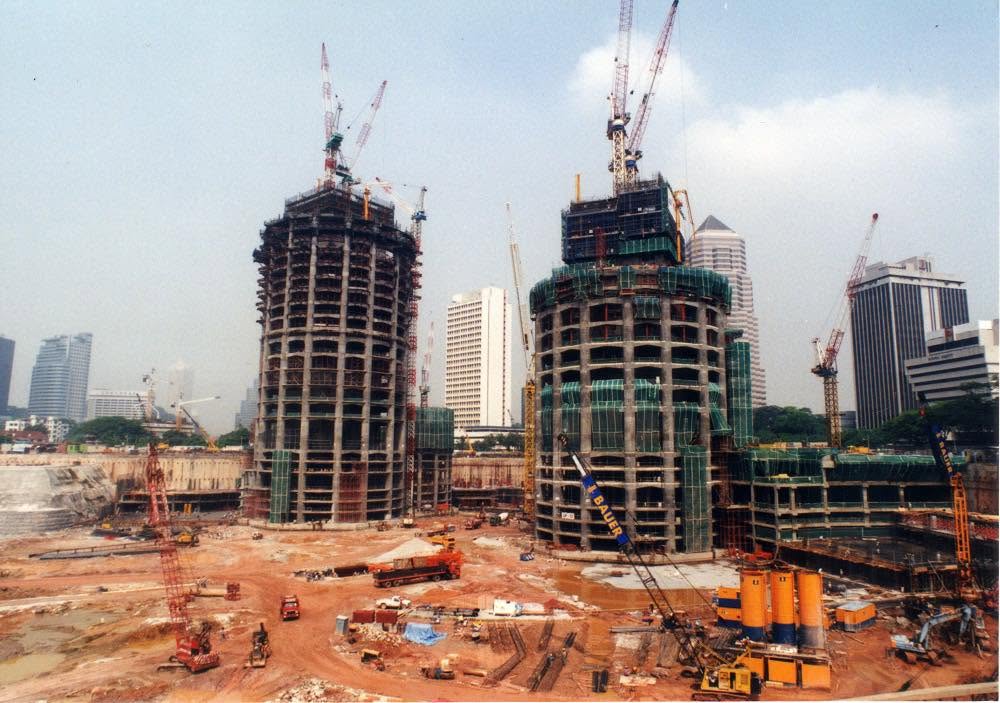
How the Petronas Twin Towers Were Built
The Petronas Twin Towers, also known as KLCC, stand 452 metres above Kuala Lumpur. The towers were once the tallest buildings in the world and remain the tallest twin towers.
The project was developed as a national landmark that reflected Malaysia’s progress and identity. Architect Cesar Pelli used the Rub el Hizb, an Islamic geometric symbol associated with order and harmony, as the basis for the floor plan.
Engineering Challenges Beneath the Site
The former Kuala Lumpur racecourse site contained unstable limestone. Engineers addressed this by installing concrete piles reaching up to 120 metres below ground and completing a continuous 52-hour concrete pour for the foundations.
Construction was divided between Hazama Corporation of Japan for Tower 1 and Samsung Engineering of South Korea for Tower 2. The approach supported the six-year project timeline while maintaining construction standards.
The Skybridge as a Safety Link
The 58.4-metre, 750-tonne skybridge connects the towers at levels 41 and 42. It provides an emergency route between the towers and was lifted into place at a height of about 170 metres using hydraulic technology.
Completed in 1996, the Petronas Twin Towers remain a defining feature of Kuala Lumpur and a symbol of Malaysian engineering, collaboration and perseverance.